Fish That Spawn and Travel and Return Home to Spawn Again

Grizzly bear fishes for a salmon during a salmon run.
The salmon run is the fourth dimension of the year when salmon, which have migrated from the ocean to fresh h2o, swim against the stream to the upper reaches of rivers, where they spawn on gravel beds. Subsequently spawning, all species of Pacific salmon and most Atlantic salmon dice,[1] and the salmon life cycle starts over again with the new generation of hatchlings. The annual run can be a major issue for predators such equally grizzly bears, bald eagles and sport fishermen. Most salmon species migrate during the autumn (September through November).[2]
Most salmon spend their juvenile life in rivers or lakes, and then migrate out to sea where they live adult lives and gain most of their body mass. When they take matured, they return to the rivers to reproduce. In that location are, however, landlocked populations of some salmon species that spend their entire life in freshwater. Usually they return with uncanny precision to the natal river where they were born, and even to the very spawning ground of their birth. It is thought that, when they are in the body of water, they use magnetoreception to locate the full general position of their natal river, and once close to the river, that they use their sense of scent to home in on the river entrance and even their natal spawning ground.
In Northwest America, salmon is a keystone species, which means the bear on they have on other life is greater than would be expected in relation to their biomass. The death of the salmon has of import consequences, since it ways the significant nutrients in their carcasses, rich in nitrogen, sulfur, carbon and phosphorus, are transferred from the ocean to terrestrial wild fauna such as bears and riparian woodlands adjacent to the rivers. This has knock-on effects not just for the next generation of salmon, merely to every species living in the riparian zones the salmon reach.[three] The nutrients can also be washed downstream into estuaries where they accumulate and provide significant support for estuarine-breeding birds.
Background [edit]

Adult ocean phase and spawning stage pink salmon (male)
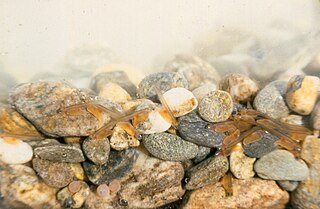
Sac fry remain in the gravel habitat of their redd (nest) until their yolk sac, or "luncheon box" is depleted

Subsequently depleting their yolk sac nutrients, the immature salmon emerge from the gravel habitat as parr to feed
Almost salmon are anadromous, a term which comes from the Greek anadromos, meaning "running upwardly".[4] Anadromous fish grow up mostly in the saltwater in oceans. When they have matured they migrate or "sew" freshwater rivers to spawn in what is called the salmon run.[5]
Anadromous salmon are Northern Hemisphere fish that spend their ocean phase in either the Atlantic Body of water or the Pacific Body of water. They do not thrive in warm water. There is only i species of salmon found in the Atlantic, ordinarily called the Atlantic salmon. These salmon run upward rivers on both sides of the ocean. Seven different species of salmon inhabit the Pacific (encounter tabular array), and these are collectively referred to as Pacific salmon. V of these species stitch rivers on both sides of the Pacific, simply two species are institute only on the Asian side.[6] In the early 19th century, Chinook salmon were successfully established in the Southern Hemisphere, far from their native range, in New Zealand rivers. Attempts to establish anadromous salmon elsewhere accept not succeeded.[seven]
| Oceans | Coasts | Species[6] | Maximum | Comment | ||
|---|---|---|---|---|---|---|
| length | weight | life span | ||||
| North Atlantic | Both sides | Atlantic salmon[8] | 150 cm | 46.8 kg | 13 years | |
| North Pacific | Both sides | Chinook salmon[nine] | 150 cm | 61.iv kg | 9 years | Also established in New Zealand |
| Chum salmon[10] | 100 cm | xv.9 kg | 7 years | |||
| Coho salmon[11] | 108 cm | fifteen.2 kg | 5 years | |||
| Pink salmon[12] | 76 cm | 6.viii kg | iii years | |||
| Sockeye salmon[13] | 84 cm | seven.7 kg | eight years | |||
| Asian side | Masu salmon[xiv] | 79 cm | ten.0 kg | |||
| Biwa salmon[15] | 44 cm | 1.iii kg | ||||
The life bike of an anadromous salmon begins and, if it survives the full course of its natural life, usually ends in a gravel bed in the upper reaches of a stream or river. These are the salmon spawning grounds where salmon eggs are deposited, for safety, in the gravel. The salmon spawning grounds are also the salmon nurseries, providing a more than protected surroundings than the ocean usually offers. After 2 to 6 months the eggs hatch into tiny larvae called sac fry or alevin. The alevin have a sac containing the remainder of the yolk, and they stay subconscious in the gravel while they feed on the yolk. When the yolk has gone they must find nutrient for themselves, and so they leave the protection of the gravel and start feeding on plankton. At this point the babe salmon are called fry. At the end of the summertime the fry develop into juvenile fish called parr. Parr feed on pocket-size invertebrates and are camouflaged with a pattern of spots and vertical bars. They remain in this stage for up to three years.[xvi] [17]
As they approach the time when they are set up to migrate out to the bounding main the parr lose their camouflage bars and undergo a procedure of physiological changes which allows them to survive the shift from freshwater to saltwater. At this point salmon are chosen smolt. Smolt spend fourth dimension in the brackish waters of the river estuary while their torso chemistry adjusts their osmoregulation to cope with the college salt levels they volition encounter in the sea.[eighteen] Smolt also abound the silvery scales which visually confuse body of water predators. When they have matured sufficiently in late spring, and are about 15 to 20 centimetres long, the smolt swim out of the rivers and into the sea. There they spend their starting time year as a mail-smolt. Post-smolt form schools with other post-smolt, and set off to find abyssal feeding grounds. They then spend up to 4 more than years as developed ocean salmon while their full swimming power and reproductive chapters develop.[16] [17] [xviii]
Then, in one of the animal kingdom'south more than farthermost migrations, the salmon return from the saltwater ocean back to a freshwater river to spawn afresh.[19]
Return from the body of water [edit]
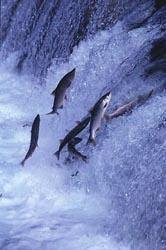
After several years wandering huge distances in the body of water, most surviving salmon return to the same natal rivers where they were spawned. Then most of them swim up the rivers until they reach the very spawning ground that was their original birthplace.[xx]
There are various theories about how this happens. Ane theory is that there are geomagnetic and chemic cues which the salmon use to guide them back to their birthplace. The fish may be sensitive to the Globe'south magnetic field, which could let the fish to orient itself in the body of water, so it tin can navigate dorsum to the estuary of its natal stream.[21]
Salmon take a strong sense of smell. Speculation well-nigh whether odours provide homing cues go back to the 19th century.[22] In 1951, Hasler hypothesised that, one time in vicinity of the estuary or entrance to its birth river, salmon may use chemical cues which they can smell, and which are unique to their natal stream, as a machinery to home onto the entrance of the stream.[23] In 1978, Hasler and his students convincingly showed that the fashion salmon locate their home rivers with such precision was indeed considering they could recognise its characteristic aroma. They further demonstrated that the smell of their river becomes imprinted in salmon when they transform into smolts, only before they migrate out to body of water.[20] [24] [25] Homecoming salmon can besides recognise characteristic smells in tributary streams equally they movement upward the main river. They may also exist sensitive to feature pheromones given off by juvenile conspecifics. There is prove that they tin can "discriminate between ii populations of their own species".[twenty] [26]
The recognition that each river and tributary has its own characteristic aroma, and the part this plays as a navigation aid, led to a widespread search for a mechanism or mechanisms that might allow salmon to navigate over long distances in the open ocean. In 1977, Leggett identified, equally mechanisms worth investigating, the use of the sun for navigation, and orientation to various possible gradients, such as temperature, salinity or chemicals gradients, or geomagnetic or geoelectric fields.[27] [28]
In that location is little testify salmon apply clues from the sun for navigation. Migrating salmon accept been observed maintaining direction at night and when it is cloudy. Too, electronically tagged salmon were observed to maintain direction even when pond in h2o much too deep for sunlight to be of utilize.[29]
In 1973, information technology was shown that Atlantic salmon have conditioned cardiac responses to electric fields with strengths similar to those found in oceans. "This sensitivity might allow a migrating fish to align itself upstream or downstream in an ocean current in the absence of fixed references."[xxx] In 1988, researchers found iron, in the form of single domain magnetite, resides in the skulls of sockeye salmon. The quantities present are sufficient for magnetoception.[31]
Tagging studies have shown a small number of fish don't find their natal rivers, but travel instead up other, normally nearby streams or rivers.[32] [33] Information technology is important some salmon stray from their domicile areas; otherwise new habitats could not be colonized. In 1984, Quinn hypothesized there is a dynamic equilibrium, controlled by genes, between homing and straying.[34] If the spawning grounds have a compatible loftier quality, then natural pick should favour the descendants that habitation accurately. However, if the spawning grounds take a variable quality, and then natural choice should favour a mixture of the descendants that stray and the descendants that dwelling house accurately.[21] [34]
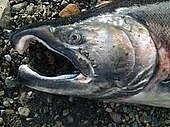
The kype of a spawning male salmon
Prior to the run up the river, the salmon undergo profound physiological changes. Fish swim past contracting longitudinal red muscle and obliquely oriented white muscles. Red muscles are used for sustained activity, such as sea migrations. White muscles are used for bursts of activity, such equally bursts of speed or jumping.[35] As the salmon comes to end of its ocean migration and enters the estuary of its natal river, its free energy metabolism is faced with two major challenges: it must supply energy suitable for swimming the river rapids, and it must supply the sperm and eggs required for the reproductive events ahead. The water in the estuary receives the freshwater discharge from the natal river. Relative to bounding main h2o, this has a high chemical load from surface runoff. Researchers in 2009 found evidence that, as the salmon encounter the resulting drop in salinity and increase in olfactory stimulation, two key metabolic changes are triggered: in that location is a switch from using red muscles for swimming to using white muscles, and at that place is an increase in the sperm and egg load. "Pheromones at the spawning grounds [trigger] a second shift to further heighten reproductive loading."[36]
The salmon also undergo radical morphological changes as they gear up for the spawning event ahead. All salmon lose the silvery bluish they had as ocean fish, and their colour darkens, sometimes with a radical change in hue. Salmon are sexually dimorphic, and the male salmon develop canine-like teeth and their jaws develop a pronounced curve or hook (kype). Some species of male salmon grow large humps.[37]
Obstacles to the run [edit]
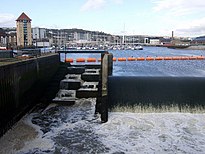
A fish ladder makes it easier for salmon to negotiate a weir
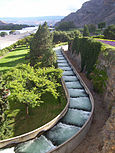
Salmon commencement the run in peak condition, the culmination of years of development in the ocean. They need high swimming and leaping abilities to battle the rapids and other obstacles the river may present, and they need a total sexual development to ensure a successful spawn at the terminate of the run. All their energy goes into the concrete rigours of the journey and the dramatic morphological transformations they must still complete before they are ready for the spawning events ahead.
The sew together the river can be exhausting, sometimes requiring the salmon to battle hundreds of miles upstream against strong currents and rapids. They cease feeding during the run.[5] Chinook and sockeye salmon from central Idaho must travel 900 miles (1,400 km) and climb nearly 7,000 feet (two,100 m) before they are ready to spawn. Salmon deaths that occur on the upriver journey are referred to as en route mortality.[38]
Salmon negotiate waterfalls and rapids by leaping or jumping. They have been recorded making vertical jumps as high as 3.65 metres (12 ft).[39] The acme that can be achieved past a salmon depends on the position of the standing wave or hydraulic leap at the base of the fall, as well every bit how deep the h2o is.[39]
Fish ladders, or fishways, are specially designed to assistance salmon and other fish to bypass dams and other man-fabricated obstructions, and proceed on to their spawning grounds further upriver.[40] Data suggest that navigation locks accept a potential to be operated as vertical slot fishways to provide increased admission for a range of biota, including poor swimmers.[41] [ clarification needed ]
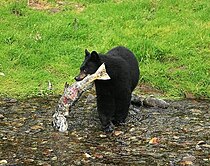
The black fur of black bears is easily spotted by salmon in daylight, and the bears fish more successfully using auditory clues at night

Skilled predators, such as bears, bald eagles and fishermen can await the salmon during the run. Unremarkably solitary animals, grizzly bears congregate by streams and rivers when the salmon spawn.[3] [42] Predation from Harbor seals, California sea lions, and Steller bounding main lions, can pose a meaning threat, even in river ecosystems.[43] [44]
Black bears also fish the salmon. Black bears usually operate during the day, only when it comes to salmon they tend to fish at night.[45] This is partly to avoid contest with the more powerful brown bears, but it is also because they take hold of more salmon at night.[46] During the day, salmon are very evasive and attuned to visual clues, but at nighttime they focus on their spawning activities, generating acoustic clues the bears tune into.[45] Black bears may also fish for salmon during the night because their black fur is easily spotted past salmon in the daytime. In 2009, researchers compared the foraging success of black bears with the white-coated Kermode carry, a morphed subspecies of the black bear. They found the Kermode bear had no more success catching salmon at night fourth dimension, but had greater success than the black bears during the solar day.[47]
Otters are likewise common predators. In 2011, researchers showed that when otters predate salmon, the salmon can "sniff them out". They demonstrated that one time otters have eaten salmon, the remaining salmon could discover and avert the waters where otter faeces was present.[48] [49]
The spawning [edit]

Spawning salmon building redds on a riffle
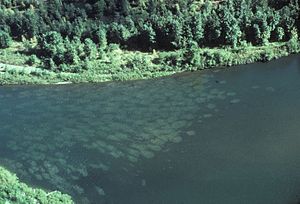
The white areas on the river bottom are completed redds

Closeup of redds on a riverbed
The term prespawn bloodshed is used to refer to fish that arrive successfully at the spawning grounds, and then die without spawning. Prespawn mortality is surprisingly variable, with one study observing rates between 3% and xc%.[38] [50] Factors that contribute to these mortalities include high temperatures,[51] [52] high river discharge rates,[53] and parasites and diseases.[50] [54] However, "at present there are no reliable indicators to predict whether an individual arriving at a spawning area will in fact survive to spawn."[38]
The eggs of a female salmon are called her roe. To lay her roe, the female salmon builds a spawning nest, called a redd, in a riffle with gravel as its streambed. A riffle is a relatively shallow length of stream where the water is turbulent and flows faster. She builds the redd past using her tail (caudal fin) to create a low-pressure zone, lifting gravel to be swept downstream, and excavating a shallow low. The redd may contain upward to 5,000 eggs, each about the size of a pea, covering xxx foursquare anxiety (ii.8 mii).[55] The eggs normally range from orange to ruby. One or more males volition approach the female in her redd, depositing his sperm, or milt, over her eggs.[56] The female then covers the eggs by disturbing the gravel at the upstream edge of the depression before moving on to make another redd. The female will make as many as seven redds before her supply of eggs is wearied.[56] [57]
Male pinkish salmon and some sockeye salmon develop pronounced humps just before they spawn. These humps may take evolved because they confer species advantages. The humps brand it less likely the salmon will spawn in the shallow water at margins of the streambed, which tend to dry out out during low water flows or freeze in winter. Further, riffles can incorporate many salmon spawning simultaneously, as in the image on the right. Predators, such as bears, will be more probable to catch the more than visually prominent humped males, with their humps projecting above the surface of the h2o. This may provide a protective buffer for the females.[58]
Dominant male person salmon defend their redds past rushing at and chasing intruders. They barrel and bite them with the canine-similar teeth they adult for the spawning event. The kypes are used to clamp around the base of the tail (caudal peduncle) of an opponent.[58]
Deterioration [edit]
The condition of the salmon deteriorates the longer they remain in fresh h2o. Once the salmon have spawned, most of them deteriorate rapidly and die. Deteriorating salmon are live, but they have begun the process of rotting to death.[59] Deteriorating salmon are sometimes chosen zombie fish.[lx] There is not much food available for them in fresh water, and they use large amounts of energy swimming upriver, exhausting themselves and burning energy reserves.[61] [62] They also accept programmed senescence, which is "characterized past immunosuppression and organ deterioration."[38] [63] [64]
Virtually zombie fish die within days of spawning, but some tin can concluding upward to a couple of weeks.[59] Once they die in the river, they are eaten by animals, or they decompose and add nutrients to the river.[61]
The Pacific salmon is a classic example of a semelparous animal. Semelparous animals reproduce once simply in their lifetime. Semelparity is a reproductive and evolutionary strategy that includes putting all available resources into maximizing reproduction, at the expense of hereafter life. Semelparity is mutual among insects and rare amongst vertebrates.[62]
Pacific salmons alive for many years in the ocean earlier pond to the freshwater stream of its birth, spawning, and so dying. Semelparity is sometimes called "big blindside" reproduction, since the unmarried reproductive event of semelparous organisms is usually large and fatal to the spawners.[65] Near Atlantic salmon also dice subsequently spawning, but non all. About five to 10%, generally female, return to the bounding main where they tin can recover and spawn once more.[18]
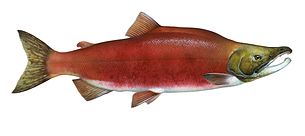
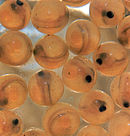
The pea-sized eggs are laid in redds

All Pacific salmon (pictured) and most Atlantic salmon dice after spawning
Keystone species [edit]
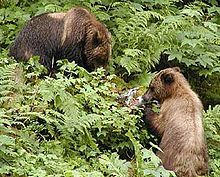
Grizzly bears tend to carry salmon carcasses into adjacent riparian areas
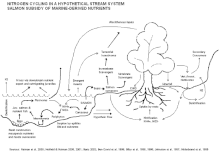
In the Pacific Northwest and Alaska, salmon is a keystone species, supporting wildlife from birds to bears and otters.[66] The bodies of salmon represent a transfer of nutrients from the ocean, rich in nitrogen, sulfur, carbon and phosphorus, to the woods ecosystem.
Grizzly bears function as ecosystem engineers, capturing salmon and carrying them into adjacent wooded areas. At that place they eolith nutrient-rich urine and faeces and partially eaten carcasses. It has been estimated that bears leave up to half the salmon they harvest on the forest floor,[67] [68] in densities that can reach 4,000 kilograms per hectare,[69] providing as much equally 24% of the total nitrogen available to the riparian woodlands.[3] The foliage of bandbox trees up to 500 g (i,600 ft) from a stream where grizzlies fish salmon take been found to contain nitrogen originating from fished salmon.[3]
Salmon continue to surprise us, showing u.s.a. new ways in which their oceanic migrations eventually permeate unabridged terrestrial ecosystems. In terms of providing nutrient and nutrients to a whole food web, we like to think of them as N America'south answer to the Serengeti'southward wildebeest.[70]
Wolves ordinarily hunt for deer. Nonetheless, a 2008 report shows that, when the salmon run starts, the wolves choose to fish for salmon, even if enough of deer are yet available.[71] "Selecting benign prey such as salmon makes sense from a safety point of view. While hunting deer, wolves usually incur serious and often fatal injuries. In improver to safety benefits we determined that salmon besides provides enhanced nutrition in terms of fat and free energy."[seventy]
The upper reaches of the Chilkat River in Alaska has peculiarly good spawning grounds. Each yr these concenter a run of up to half a million chum salmon. As the salmon sew together the river, bald eagles arrive in their thousands to banquet at the spawning grounds. This results in some of the world's largest congregations of baldheaded eagles. The number of participating eagles is directly correlated with the number of spawning salmon.[72]
Residue nutrients from salmon can also accumulate downstream in estuaries. A 2010 study showed the density and diversity of many estuarine breeding birds in the summertime "were strongly predicted by salmon biomass in the fall."[73] Anadromous salmon provide nutrients to these "diverse assemblages ... ecologically comparable to the migrating herds of wildebeest in the Serengeti".[69]
Prospects [edit]
The futurity of salmon runs worldwide depends on many factors, well-nigh of which are driven by man actions. Amongst the primal driving factors are (1) harvest of salmon by commercial, recreational, and subsistence fishing, (2) alterations in stream and river channels, including construction of dikes and other riparian corridor modifications, (iii) electricity generation, overflowing control, and irrigation supplied past dams, (four) alteration by humans of freshwater, estuarine, and marine environments used by salmon, coupled with aquatic changes due to climate and bounding main circulatory regimes, (5) h2o withdrawals from rivers and reservoirs for agricultural, municipal, or commercial purposes, (half dozen) changes in climate caused at least in part by human activities, (7) competition from non-native fishes, (8) salmon predation by marine mammals, birds, and other fish species, (9) diseases and parasites, including those from outside the native region, and (10) reduced food replenishment from decomposing salmon.[74]
In 2009, NOAA brash that connected runoff into Due north American rivers of three widely used pesticides containing neurotoxins will "jeopardize the connected beingness" of endangered and threatened Pacific salmon.[75] [76] Global warming could run into the finish of some salmon runs past the end of the century, such as the Californian runs of Chinook salmon.[77] [78] A 2010 United Nations report says increases in acidification of oceans means shellfish such equally pteropods, an important component of the sea salmon nutrition, are finding it difficult to build their aragonite shells.[79] At that place are concerns that this too may endanger future salmon runs.[fourscore]
In popular culture [edit]
A video game in 1982 chosen Salmon Run. The player takes the role of Sam the Salmon, swimming upriver to mate. Forth the way he encounters waterfalls, a behave, fishermen, and seagulls.
In the Disney animated feature movie, Brother Conduct, Kenai and Koda reached the salmon run and met a large group of bears led by Tug at the Annual Salmon Run. Featuring the song Welcome by The Blind Boys of Alabama and Phil Collins.
Notable runs [edit]
| External video | |
|---|---|
 Grizzly Bears Catching Salmon on YouTube – Nature's Great Events: The Great Salmon Run Grizzly Bears Catching Salmon on YouTube – Nature's Great Events: The Great Salmon Run | |
| Baldheaded Eagle catches salmon on YouTube – BBC Nature's Great Events - The Great Salmon Run | |
| The Keen Salmon Run on YouTube – BBC Nature's Great Events | |
| Nimbus Hatchery Fish Ladder on YouTube | |
| Life Bicycle of Salmon on YouTube | |
| Life Cycle of Salmon on YouTube – Discovery Channel | |
| The Salmon'due south Lifecycle Atlantic Salmon Trust | |
| Sockeye Salmon Run 2010 on YouTube | |
| Spawning salmon constructing a redd on YouTube | |
| Raising salmon on YouTube | |
| Salmon life wheel song on YouTube |
- Adams River (British Columbia)
- Chilkat River (Alaska)
- Columbia River (British Columbia, The states)
- Copper River (Alaska)
- Fraser River (British Columbia)
- Kenai River (Alaska)
- River Spey (Scotland)
- River Tana (Norway, Finland)
- River Tay (Scotland)
- River Tweed (border of Scotland and England)
- River Tyne (England)
- Serpent River (The states)
- Yukon River (Alaska, Yukon, British Columbia)
See likewise [edit]
- Salmonidae
- Animal navigation
- Ecology touch of reservoirs
- June hogs
- Natal homing
- Olfactory navigation
- Pre-spawn mortality in coho salmon
- Sardine run
References [edit]
- ^ Atlantic salmon, Scottish Natural Heritage. Retrieved 25 January 2018.
- ^ "Questions and Answers Nigh Salmon". Western Fisheries Research Eye. U.S. Geological Survey.
- ^ a b c d Helfield, J. & Naiman, R. (2006), "Keystone Interactions: Salmon and Bear in Riparian Forests of Alaska" (PDF), Ecosystems, 9 (two): 167–180, doi:ten.1007/s10021-004-0063-five, S2CID 28989920
- ^ "Anadromous". Merriam-Webster Dictionary.
- ^ a b Moyle, p. 188
- ^ a b NOAA (2011) NEFSC Fish FAQ Archived 2012-01-04 at the Wayback Machine NOAA Fisheries Service. Retrieved 17 December 2011.
- ^ Walrond C (2010) Trout and salmon – Chinook salmon Te Ara - the Encyclopedia of New Zealand. Updated 9 September 2010.
- ^ Froese, Rainer; Pauly, Daniel (eds.) (2011). "Salmo salar " in FishBase. December 2011 version.
- ^ Froese, Rainer; Pauly, Daniel (eds.) (2011). "Oncorhynchus tshawytscha " in FishBase. Dec 2011 version.
- ^ Froese, Rainer; Pauly, Daniel (eds.) (2011). "Oncorhynchus keta " in FishBase. December 2011 version.
- ^ Froese, Rainer; Pauly, Daniel (eds.) (2011). "Oncorhynchus kisutch " in FishBase. December 2011 version.
- ^ Froese, Rainer; Pauly, Daniel (eds.) (2011). "Oncorhynchus gorbuscha " in FishBase. December 2011 version.
- ^ Froese, Rainer; Pauly, Daniel (eds.) (2011). "Oncorhynchus nerka " in FishBase. December 2011 version.
- ^ Froese, Rainer; Pauly, Daniel (eds.) (2011h). "Oncorhynchus masou " in FishBase. December 2011h version.
- ^ Froese, Rainer; Pauly, Daniel (eds.) (2011). "Oncorhynchus rhodurus " in FishBase. December 2011 version.
- ^ a b Bley, Patrick W and Moring, John R (1988) Freshwater and Bounding main Survival of Atlantic Salmon and Steelhead: A Synopsis" US Fish and Wildlife Service.
- ^ a b Lindberg, Dan-Erik (2011) Atlantic salmon (Salmo salar) migration beliefs and preferences in smolts, spawners and kelts Introductory Inquiry Essay, Swedish University of Agricultural Sciences.
- ^ a b c Atlantic Salmon Trust Salmon Facts Archived 2011-11-30 at the Wayback Automobile Retrieved xv Dec 2011.
- ^ Crossin, Thousand. T.; Hinch, S. G.; Cooke, S. J.; Cooperman, M. South.; Patterson, D. A.; Welch, D. Westward.; Hanson, M. C.; Olsson, I; English, K. K.; Farrell, A. P. (2009). "Mechanisms Influencing the Timing and Success of Reproductive Migration in a Capital Breeding Semelparous Fish Species, the Sockeye Salmon" (PDF). Physiological and Biochemical Zoology. 82 (six): 635–52. doi:x.1086/605878. PMID 19780650. S2CID 542744. Archived (PDF) from the original on 26 Apr 2012.
- ^ a b c Moyle, p. 190
- ^ a b Lohmann K, Putnam Northward, Lohmann C (2008). "Geomagnetic imprinting: a unifying hypothesis of long-distance natal homing in salmon and sea turtles". Proceedings of the National Academy of Sciences. 105 (49): 19096–19101. doi:x.1073/pnas.0801859105. PMC2614721. PMID 19060188.
- ^ Trevanius GR (1822) Biologie oder Philosophic der lebenden Natur fur Naturforscher und Arzte, vol VI Rower, Gottingen.
- ^ Hasler Advertizement (1951). "Discrimination of stream odors by fishes and its relation to parent stream behavior". American Naturalist. 85 (823): 223–238. doi:10.1086/281672. JSTOR 2457678. S2CID 86794008.
- ^ Hasler AD and Scholtz AT (1978) "Olfactory imprinting and homing in salmon: Investigations into the machinery of the imprinting process, pp. 356-369 in Animate being migration, navigation, and homing, Springer-Verlag. ISBN 978-3-540-08777-9.
- ^ Dittman A, Quinn T (1996). "Homing in Pacific salmon: mechanisms and ecological basis". Journal of Experimental Biological science. 199 (Pt i): 83–91. doi:10.1242/jeb.199.1.83. PMID 9317381.
- ^ Groot C, Quinn TP, Hara TJ (1986). "Responses of migrating adult sockeye salmon (Oncorhynchus nerka) to population-specific odours". Can. J. Zool. 64 (4): 926–932. doi:10.1139/z86-140. S2CID 85201613.
- ^ Leggett WC (1977). "The environmental of fish migrations" (PDF). Almanac Review of Ecology and Systematics. 8: 285–308. doi:10.1146/annurev.es.08.110177.001441. JSTOR 2096730. Archived from the original (PDF) on 6 June 2010.
- ^ Moyle, p. 191
- ^ Ogura M, Ishida Y (1995). "Homing behavior and vertical movements of 4 species of Pacific salmon (Oncorhynchus spp.) in the key Bering Sea". Canadian Periodical of Fisheries and Aquatic Sciences. 52 (3): 532–540. doi:10.1139/f95-054.
- ^ Rommel SA, McCleave JD (1973). "Sensitivity of American Eels (Anguilla rostrata) and Atlantic Salmon (Salmo salar) to Weak Electrical and Magnetic Fields". Periodical of the Fisheries Research Board of Canada. 30 (5): 657–663. doi:ten.1139/f73-114.
- ^ Walker MM, Quinn TP, Kirschvink JL, Groot C (1988). "Production of unmarried-domain magnetite throughout life by sockeye salmon, Oncorhynchus nerka" (PDF). Periodical of Experimental Biology. 140: 51–63. doi:10.1242/jeb.140.1.51. PMID 3204338.
- ^ Quinn TP, Nemeth RS, McIsaac DO (1991). "Homing and straying patterns of autumn chinook salmon in the lower Columbia River". Trans Am Fish Soc. 120 (2): 150–156. doi:10.1577/1548-8659(1991)120<0150:HASPOF>ii.3.CO;2.
- ^ Tallman RF, Healey MC (1994). "Homing, straying, and gene menses among seasonally separated populations of chum salmon (Oncorhynchus keta)". Tin can J Fish Aquat Sci. 51 (three): 577–588. doi:ten.1139/f94-060.
- ^ a b Quinn TP (1984) "Mechanisms of Migration in Fishes Eds: McCleave JD, Arnold GP, Dodson JJ, Neill WH, pp. 357–362. Plenum Press. ISBN 978-0-306-41676-seven.
- ^ Kapoor BG and Khanna B (2004) Ichthyology handbook. Springer. pp. 137–140. ISBN 978-three-540-42854-1.
- ^ Miller KM, Schulze Advertising, Ginther North, Li S, Patterson DA, Farrell AP, Hinch SG (2009). "Salmon spawning migration: metabolic shifts and environmental triggers" (PDF). Comparative Biochemistry and Physiology D. four (2): 75–89. doi:ten.1016/j.cbd.2008.11.002. PMID 20403740.
- ^ Section of Fish and Wildlife (2011) Salmon and steelhead life cycle and habitat information Washington. Retrieved 3 January 2012.
- ^ a b c d Jeffries KM, SG Hinch SG, MR Donaldson MR, Gale MK, Burt JM, Thompson LA, Farrell AP, Patterson DA, Miller KM (2011). "Temporal changes in blood variables during final maturation and senescence in male person sockeye salmon Oncorhynchus nerka: reduced osmoregulatory power can predict mortality" (PDF). Periodical of Fish Biological science. 79 (ii): 449–65. doi:10.1111/j.1095-8649.2011.03042.x. PMID 21781102.
- ^ a b Beach MH (1984). "Fish pass design - criteria for the design and blessing of fish passes and other structures to facilitate the passage of migratory fish in rivers" (PDF). Fish Res Tech Rep. 78: 1–46.
- ^ Michigan DNR. What is a Fish Ladder? Retrieved xv December 2011.
- ^ Silva, Sergio; Lowry, Maran; Macaya-Solis, Consuelo; Byatt, Barry; Lucas, Martyn C. (2017). "Can navigation locks be used to assist migratory fishes with poor pond performance laissez passer tidal barrages? A exam with lampreys". Ecological Engineering. 102: 291–302. doi:10.1016/j.ecoleng.2017.02.027.
- ^ Hilderbrand, Thousand.; Hanley, T.; Robbins, C. & Schwartz, C. (1999). "Role of Brown Bears (Ursus arctos) in the Flow of Marine Nitrogen into a Terrestrial Ecosystem". Oecologia. 121 (4): 546–550. Bibcode:1999Oecol.121..546H. CiteSeerXx.1.1.160.450. doi:10.1007/s004420050961. PMID 28308364. S2CID 12028991.
- ^ Seal & Bounding main King of beasts Facts of the Columbia River & Adjacent Nearshore Marine Areas (PDF), NOAA, March 2008, archived from the original (PDF) on 23 July 2012, retrieved 16 April 2012
- ^ "Endangered Seals Eating Endangered Salmon", Bryant Park Project, NPR, six May 2008
- ^ a b Klinka DR, Reimchen TE (2009). "Darkness, twilight, and daylight foraging success of bears (Ursus Americanus) on salmon in coastal British Columbia" (PDF). Periodical of Mammalogy. 90: 144–149. doi:10.1644/07-MAMM-A-200.i.
- ^ Reimchen TE (2009). "Nocturnal foraging behaviour of blackness bears Ursus americanus on Moresby Island British Columbia" (PDF). Canadian Field-Naturalist. 112: 446–450.
- ^ Klinka DR, Reimchen TE (2009). "Adaptive coat color polymorphism in the Kermode bear of littoral British Columbia" (PDF). Biological Journal of the Linnean Lodge. 98 (3): 479–488. doi:10.1111/j.1095-8312.2009.01306.x.
- ^ Roberts LJ, de Leaniz CG (2011). "Something smells fishy: predator-naive salmon use nutrition cues, not kairomones, to recognize a sympatric mammalian predator". Animal Behaviour. 82 (iv): 619–625. doi:10.1016/j.anbehav.2011.06.019. S2CID 53163932.
- ^ PlanetEarth (12 September 2011). Salmon can sniff out predators Archived 2011-10-20 at the Wayback Machine.
- ^ a b Gilhousen P (1990) Prespawning mortalities of sockeye salmon in the Fraser River system and possible causal factors International Pacific Salmon Fisheries Commission, Message 26, 1–58.
- ^ Crossin GT, Hinch SG, Cooke SJ, Welch DW, Patterson DA, Jones SR, Lotto AG, Leggatt RA, Mathes MT, Shrimpton JM, Van der Kraak Yard, Farrell AP (2008). "Exposure to loftier temperature influences the behaviour, physiology, and survival of sockeye salmon during spawning migration" (PDF). Canadian Periodical of Zoology. 86 (2): 127–140. doi:10.1139/Z07-122.
- ^ Farrell AP, Hinch SG, Cooke SJ, Patterson DA, Crossin GT, Lapointe Thou, Mathes MT (2008). "Pacific salmon in hot h2o: applying metabolic scope models and biotemetry to predict the success of spawning migrations". Physiological and Biochemical Zoology. 81 (6): 697–708. doi:10.1086/592057. PMID 18922081. S2CID 1397402.
- ^ Rand PS, Hinch SG, Morrison J, Foreman MG, MacNutt MJ, Macdonald JS, Healey MC, Farrell AP, Higgs DA (2006). "Effects of river discharge, temperature, and future climates on energetics and mortality of adult migrating Fraser River sockeye salmon" (PDF). Transactions of the American Fisheries Social club. 135 (3): 655–667. doi:10.1577/T05-023.1.
- ^ Jones SR, Prosperi-Porta G, Dawe SC, Barnes DP (2003). "Distribution, prevalence and severity of Parvicapsula minibicornis infections among anadromous salmonids in the Fraser River, British Columbia, Canada" (PDF). Diseases of Aquatic Organisms. 54 (i): 49–54. doi:x.3354/dao054049. PMID 12718470.
- ^ McGrath, Susan. "Spawning Hope". Audubon Society. Archived from the original on 27 September 2007. Retrieved 17 November 2006.
- ^ a b Fish and Wildlife Services (2011) Pacific Salmon, (Oncorhynchus spp.) U.S. Fish and Wildlife Services. Accessed: 28 December 2011.
- ^ Department of Fish and Wild animals (2011) What is a redd? Washington. Retrieved 3 Jan 2012.
- ^ a b Groot C and Margolis 50 (1991) Pacific salmon life histories. UBC Press. p. 144. ISBN 978-0-7748-0359-5.
- ^ a b "Zombie salmon are the truthful 'living dead' and now is the fourth dimension to see them, experts say". The Sacramento Bee.
- ^ "U.S. Fish & Wildlife Service - Zombie Fish". www.fws.gov . Retrieved 16 Feb 2021.
- ^ a b "Why do salmon modify colour and die afterwards they spawn?". www.usgs.gov . Retrieved 16 Feb 2021.
- ^ a b Alessandra Bergamin (22 November 2013). "Why do Pacific Salmon Die After Spawning? -". Bay Nature . Retrieved 16 Feb 2021.
- ^ Dickhoff WW (1989) "Salmonids and annual fishes: death later sexual practice" Pages 253–266. In: Schreibman MP and Scanes C G (eds) Development, maturation, and senescence of neuroendocrine systems, University of California. ISBN 978-0-12-629060-8.
- ^ Finch CE (1990) Longevity, Senescence, and the Genome University of Chicago Press. ISBN 978-0-226-24889-ix.
- ^ Ricklefs RE and Miller GK (2000) Environmental W.H. Freeman. ISBN 978-0-7167-2829-0.
- ^ Willson MF, Halupka KC (1995). "Anadromous Fish as Keystone Species in Vertebrate Communities" (PDF). Conservation Biology. ix (three): 489–497. doi:10.1046/j.1523-1739.1995.09030489.x. Archived from the original (PDF) on 28 November 2011.
- ^ Reimchen TE (2001). "Salmon nutrients, nitrogen isotopes and coastal forests" (PDF). Ecoforestry. 16: thirteen.
- ^ Quinn, T.; Carlson, S.; Gende, S. & Rich, H. (2009). "Transportation of Pacific Salmon Carcasses from Streams to Riparian Forests by Bears" (PDF). Canadian Periodical of Zoology. 87 (3): 195–203. doi:10.1139/Z09-004. Archived from the original (PDF) on sixteen June 2012.
- ^ a b Reimchen TE, Mathewson DD, Hocking Medico, Moran J (2002). "Isotopic testify for enrichment of salmon-derived nutrients in vegetation, soil, and insects in riparian zones in littoral British Columbia" (PDF). American Fisheries Club Symposium. twenty: ane–12.
- ^ a b ScienceDaily (1 September 2008) Wolves Would Rather Eat Salmon.
- ^ Darimont CT, Paquet PC, Reimchen TE (2008). "Spawning salmon disrupt trophic coupling between wolves and ungulate prey in littoral British Columbia". BMC Ecology. eight: 14. doi:10.1186/1472-6785-8-14. PMC2542989. PMID 18764930.
- ^ Hansen A, EL Boeker EL and Hodges JI (2010) "The Population Ecology of Baldheaded Eagles Along the Pacific Northwest Declension" Archived 2012-04-26 at the Wayback Machine, pp. 117–133 in PF Schempf and BA Wright, Bald Eagles in Alaska, Hancock House Pub. ISBN 978-0-88839-695-2.
- ^ Field RD, Reynolds JD (2011). "Sea to sky: impacts of residual salmon-derived nutrients on estuarine breeding bird communities" (PDF). Proceedings of the Royal Society B: Biological Sciences. 278 (1721): 3081–3088. doi:10.1098/rspb.2010.2731. PMC3158931. PMID 21325324. Archived from the original (PDF) on four October 2011.
- ^ Stouder, Deanna J. (1997). Pacific Salmon & Their Ecosystems : Condition and Future Options. Bisson, Peter A., Naiman, Robbert J., Duke, Marcus G. Boston, MA: Springer US. ISBN978-1-4615-6375-four. OCLC 840286102.
- ^ NOAA (2009) [ Registration of Pesticides Containing Carbaryl, Carbofuran, and Methomyl] Biological Stance, National Marine Fisheries Service.
- ^ Surroundings News Service (21 Apr 2009) 3 Common Pesticides Toxic to Salmon.
- ^ Thompson LC, Escobar MI, Mosser CM, Purkey DR, Yates D, Moyle Atomic number 82 (2012). "Water Direction Adaptations to Prevent Loss of Leap-Run Chinook Salmon in California nether Climate Change". Journal of H2o Resources Planning and Management. 138 (5): 465–478. doi:x.1061/(ASCE)WR.1943-5452.0000194. S2CID 109723886.
- ^ ScienceDaily (1 September 2011) Warming Streams Could Be the End for Spring-Run Chinook Salmon in California.
- ^ UNEP (2010) Environmental Consequences of Sea Acidification: A Threat to Food Security
- ^ The Telegraph (3 December 2010). Cancun climate height: Uk'due south salmon at risk from ocean acidification.
Cited sources [edit]
- Moyle Atomic number 82, Cech JJ (2004). Fishes, An Introduction to Ichthyology (5th ed.). Benjamin Cummings. ISBN978-0-13-100847-2.
Further reading [edit]
- Froese, Rainer; Pauly, Daniel (eds.) (2011). "Oncorhynchus mykiss " in FishBase. Dec 2011 version.
- USDA Forest Service, Salmon/Steelhead Pacific Northwest Fisheries Program. Retrieved xxx December 2011.
- Knapp 1000, Roheim CA and Anderson JL (2007) The Neat Salmon Run: Competition Betwixt Wild and Farmed Salmon World Wildlife Fund.
- Mozaffari, Ahmad and Alireza Fathi (2013) "A natural-inspired optimization machine based on the annual migration of salmons in nature" arXiv:1312.4078.
- Quinn, Thomas P. (2005) The Behavior and Ecology of Pacific Salmon and Trout UBC Press. ISBN 978-0-7748-1128-vi.
- Magnetoception and natal homing
- Bandoh H, Kida I, Ueda H (2011). "Olfactory Responses to Natal Stream Water in Sockeye Salmon by Assuming fMRI". PLOS ONE. 6 (1): e16051. Bibcode:2011PLoSO...616051B. doi:10.1371/journal.pone.0016051. PMC3022028. PMID 21264223.
- Bracis, Chloe (2010) A model of the body of water migration of Pacific salmon University of Washington.
- Johnsen Due south, Lohmann KJ (2005). "The physics and neurobiology of magnetoreception" (PDF). Nature Reviews Neuroscience. 6 (9): 703–712. doi:x.1038/nrn1745. PMID 16100517. S2CID 13996233. Archived from the original (PDF) on thirty June 2007.
- Johnsen Due south, Lohmann KJ (2008). "Magnetoreception in animals". Physics Today. 61 (3): 29–35. Bibcode:2008PhT....61c..29J. doi:10.1063/i.2897947.
- Lohmann KJ, Lohmann CM, Endres CS (2008). "The sensory ecology of sea navigation". J Exp Biol. 211 (xi): 1719–1728. doi:10.1242/jeb.015792. PMID 18490387.
- Isle of mann South, Sparks NH, Walker MM, Kirschvink JL (1988). "Ultrastructure, morphology and organization of biogenic magnetite from sockeye salmon, Oncorhynchus nerka: implications for magnetoreception" (PDF). J Exp Biol. 140: 35–49. doi:x.1242/jeb.140.1.35. PMID 3204335.
- Metcalfe J, Arnold G and McDowall R (2008) "Migration" pp. 175–199. In: John D. Reynolds, Handbook of fish biological science and fisheries, Volume 1, John Wiley & Sons. ISBN 978-0-632-05412-1.
- Moore A, Privitera L and Riley WD (2013) "The behaviour and physiology of migrating Atlantic salmon" In: H Ueda and G Tsukamoto (eds),Physiology and Ecology of Fish Migration, CRC Printing, pp. 28–55. ISBN 9781466595132.
- Ueda, Hiroshi (2013) "Physiology of imprinting and homing migration in Pacific salmon" In: H Ueda and K Tsukamoto (eds),Physiology and Ecology of Fish Migration, CRC Press, pp. i–27. ISBN 9781466595132.
- Walker MM, Diebel CE, Haugh CV, Pankhurst PM, Montgomery JC, Green CR (1997). "Structure and function of the vertebrate magnetic sense". Nature. 390 (6658): 371–vi. Bibcode:1997Natur.390..371W. doi:10.1038/37057. PMID 20358649. S2CID 4386772.
- Wired. Hacking Salmon's Mental Compass to Save Endangered Fish 2 December 2008.
- Nitrogen
- Cederholm CJ, Kunze Physician, Murota T, Sibatani T (1999). "Pacific salmon carcasses: essential contributions of nutrients and energy for aquatic and terrestrial ecosystems" (PDF). Fisheries. 24 (ten): half-dozen–xv. doi:ten.1577/1548-8446(1999)024<0006:psc>ii.0.co;2.
- Gresh T, Lichatowich J, Schoonmaker P (2000). "Salmon Pass up Creates Nutrient Deficit in Northwest Streams". Fisheries. 15 (ane): 15–21. doi:x.1577/1548-8446(2000)025<0015:AEOHAC>2.0.CO;2. Archived from the original on 9 May 2008.
- Hocking MD, Reynolds JD (2011). "Impacts of salmon on riparian constitute diversity" (PDF). Science. 331 (6024): 1609–1612. Bibcode:2011Sci...331.1609H. doi:10.1126/scientific discipline.1201079. PMID 21442794. S2CID 30725341. [ permanent dead link ]
- Naiman RJ, Bilby RE, Schindler DE, Helfield JM (2002). "Pacific salmon, nutrients, and the dynamics of freshwater and riparian ecosystems" (PDF). Ecosystems. v (4): 399–417. doi:10.1007/s10021-001-0083-3. S2CID 5607299. Archived from the original (PDF) on 24 April 2012.
- Ruckelshaus MH, Levin P, Johnson JB, Kareiva PM (2002). "The Pacific salmon wars: what science brings to the challenge of recovering species" (PDF). Annu. Rev. Ecol. Syst. 33: 665–706. doi:10.1146/annurev.ecolsys.33.010802.150504.
- Resilience
- Bottom DL, Jones KK, Simenstad CA, Smith CL (2009). "Reconnecting social and ecological resilience in salmon ecosystems" (PDF). Ecology and Society. fourteen (1): 5. doi:10.5751/es-02734-140105.
- Lesser DL, Jones KK, Simenstad CA and Smith CL (Eds.) (2010) Pathways to Resilient Salmon Ecosystems Ecology and Society, Special Characteristic.
External links [edit]
- Putting a Cost on Salmon True Slant, 9 July 2009.
- Fish passage at dams Northwest Power and Conservation Council. Retrieved 17 December 2011.
- Mystery Disease Found in Pacific Salmon Wired, thirteen Jan 2011.
- Pacific Salmon: Anadromous Lifestyles US National Park Service.
- Study takes long-term, diversified view of salmon issues Mount Shasta News, thirty September 2009.
Source: https://en.wikipedia.org/wiki/Salmon_run
0 Response to "Fish That Spawn and Travel and Return Home to Spawn Again"
Postar um comentário